White bread is the first of seven loaves on Dr David Unwin’s bread chart, which compares them slice for slice. Every row on that chart uses the same small 30g slice. That is thinner than most slices from a large sandwich loaf, and closer to a slice from a small bakery loaf. A medium supermarket slice usually weighs more, and the figure rises with the weight.
White bread is made from refined wheat flour, milled from the starchy centre of the grain with most of the bran and germ taken out. Almost all of its carbohydrate is starch rather than sugar, so the “of which sugars” line on the packet shows very little. Digestion breaks the starch down into glucose. The glycaemic index of 71 printed on the chart describes how quickly that happens; 70 and above is the band conventionally called high.
The chart prints both a glycaemic load and a teaspoon figure for this slice, so neither has been worked out for this page.
A second chart in the same series, “White, brown or green foods?”, shows white bread as two slices weighing 60g together, with a load of 22 and a teaspoon figure of 8. Those figures are not exactly double the single-slice row. The two charts draw on different entries in the published GI tables, and the calculator uses the single-slice chart. White and brown loaves are set out together, with all seven breads from the chart, in why brown bread is still sugar.
The numbers
- Glycaemic index
- 71
- Available carbohydrate
- not printed on this source
- Glycaemic load
- 10, as printed on the source
- Teaspoons
- 3.7
Glycaemic load printed on the source: 10
Teaspoons: 10 ÷ 2.73 = 3.7
Source
Read from a published chart: Bread (sugar infographic). Dr David Unwin. Public Health Collaboration.
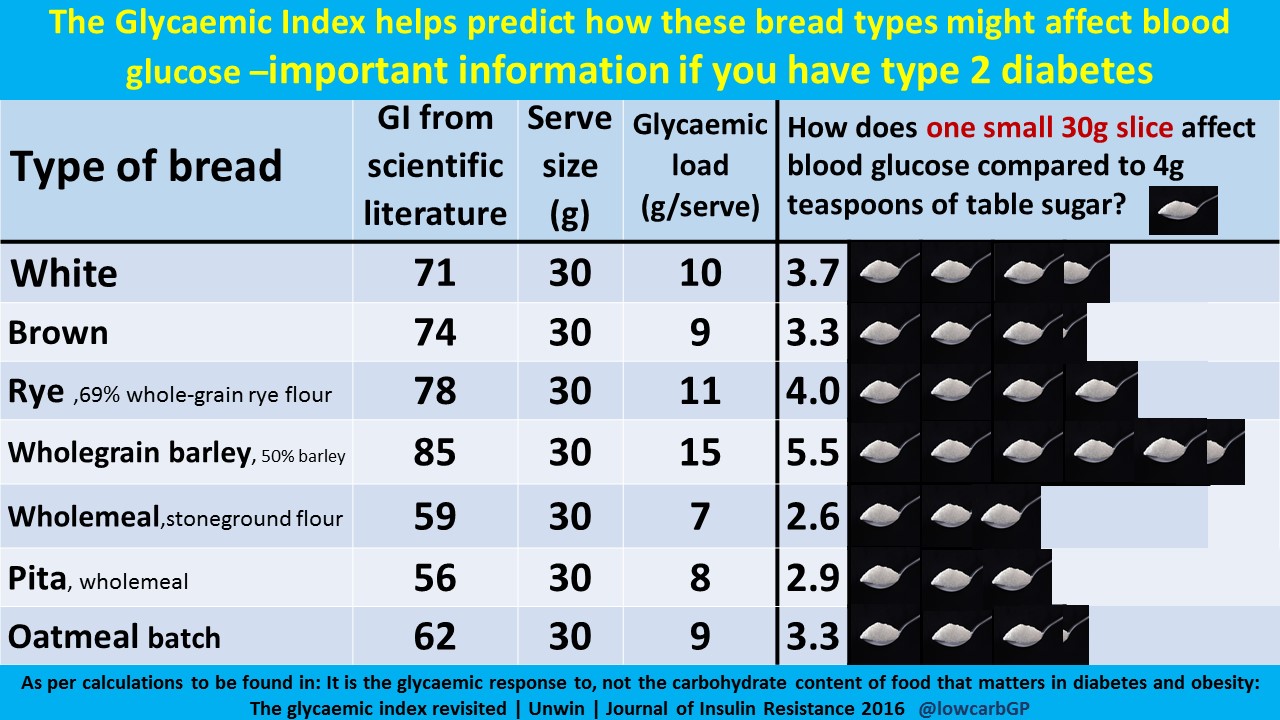
The teaspoon-of-sugar method is the work of Dr David Unwin, and his sugar infographics are published by the Public Health Collaboration at phcuk.org/sugar and used here with PHC's permission. Full provenance for every food is on the sources page.
Side by side
-
White bread
1 small slice (30g)
3.7 teaspoons
- Broccoli, boiled
about 1 cup (80g)
0.2 teaspoons
- Eggs
1 large egg (60g)
0.0 teaspoons
- Apple (Golden Delicious)
1 small apple (120g)
2.2 teaspoons