Broccoli sits one row above eggs at the foot of Dr Unwin’s common foods chart, and the 2016 paper uses it to mark the low end of the chart’s range. An 80g portion of boiled broccoli, about a cup of florets, contains so little available carbohydrate that its glycaemic index barely affects the result.
The published sources show this in an unusual way: they do not agree on the GI. The common foods chart prints 15. Figure 1 of the paper, its version of the same chart, prints 54, and the paper’s text describes broccoli as having a “moderately high GI of 54” while having little effect on blood glucose. A footnote says the broccoli value was approximated from carbohydrate composition. Both sources give the same teaspoon figure for 80g.
A second chart, “White, brown or green foods?”, shows broccoli at a larger 250g portion, with a glycaemic load of 0.3 and a figure of 0.1 teaspoons. That does not scale up from the 80g portion. The smaller-portion value from the common foods chart is used here, and both are recorded on the sources page.
At figures this small, rounding dominates. A chart printing to one decimal place cannot separate loads that differ by a few hundredths of a gram, and the back-calculated load on this page carries the same imprecision.
The fruits vs vegetables chart has no broccoli row, but names it in a side note with salad leaves, courgette and cauliflower. Cabbage, another brassica, has a row on that chart and a page here: cabbage.
The numbers
- Glycaemic index
- 15
- Available carbohydrate
- not printed on this source
- Glycaemic load
- 0.5, back-calculated from the teaspoon figure
- Teaspoons
- 0.2
Teaspoons printed on the source: 0.2
Glycaemic load: 0.2 × 2.73 = 0.5
Source
Read from a published chart: Common foods (sugar infographic). Dr David Unwin. Public Health Collaboration.
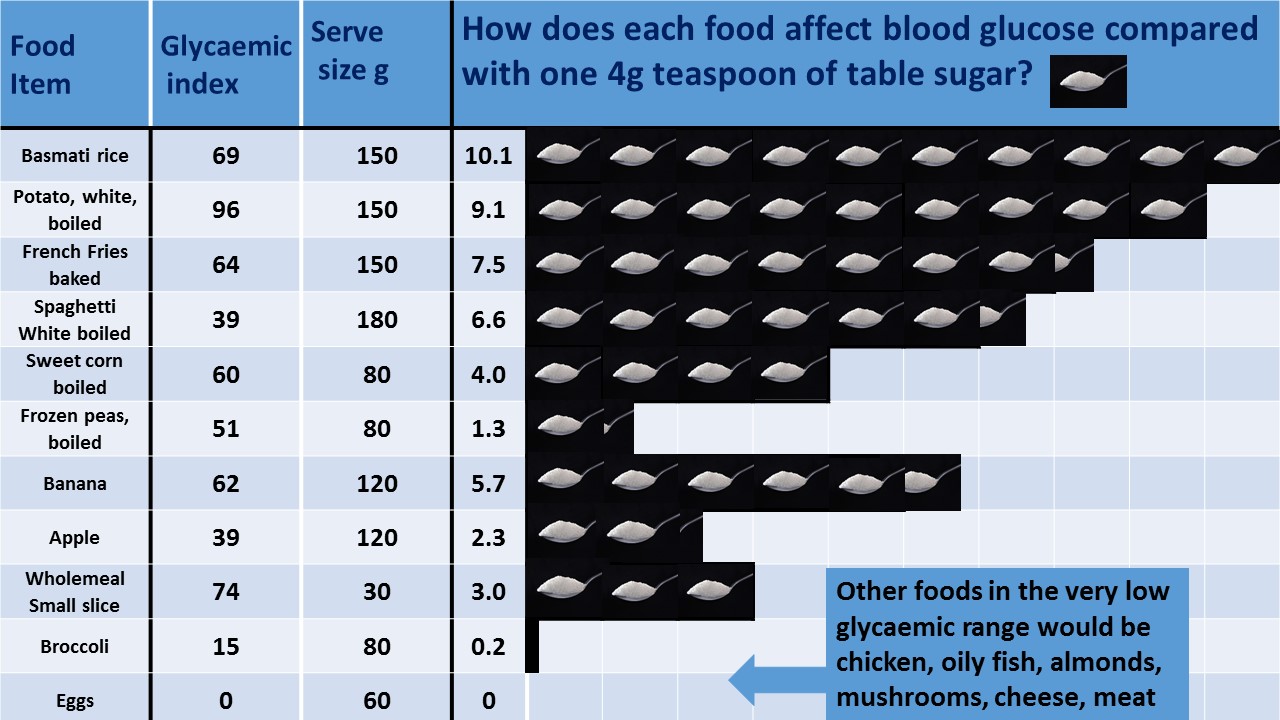
The teaspoon-of-sugar method is the work of Dr David Unwin, and his sugar infographics are published by the Public Health Collaboration at phcuk.org/sugar and used here with PHC's permission. Full provenance for every food is on the sources page.
Side by side
-
Broccoli, boiled
about 1 cup (80g)
0.2 teaspoons
- Basmati rice, boiled
1 bowl, cooked (150g)
10.1 teaspoons
- White bread
1 small slice (30g)
3.7 teaspoons