Cabbage has the lowest glycaemic index of any food in this dataset with a GI above zero, at 10. It appears on Dr Unwin’s fruits vs vegetables chart at 80g, about a cup of shredded leaves.
That chart lists four vegetables and four fruits. Cabbage is the last of the vegetable rows, below boiled potato, sweet corn and frozen peas, and an arrow beside it points to a note naming salad leaves, broccoli, courgette and cauliflower as similar.
Cabbage is mostly water. Its small carbohydrate content is a mix of sugars and fibre, with very little starch. The chart does not say whether the cabbage was raw or cooked, or which kind: white, green, red and savoy cabbages differ somewhat in composition.
The chart prints the GI and the teaspoon figure, 0.1, the smallest figure above zero that a chart printing to one decimal place can show. The glycaemic load was back-calculated from that rounded figure, so the true load could be anywhere in a narrow range around it. At this scale, rounding matters more than any other source of error.
Fermented cabbage, such as sauerkraut or kimchi, and coleslaw in a sweetened dressing, are different foods and are not covered by this row.
Other brassicas in the dataset are broccoli and cauliflower.
The numbers
- Glycaemic index
- 10
- Available carbohydrate
- not printed on this source
- Glycaemic load
- 0.3, back-calculated from the teaspoon figure
- Teaspoons
- 0.1
Teaspoons printed on the source: 0.1
Glycaemic load: 0.1 × 2.73 = 0.3
Source
Read from a published chart: Fruits vs vegetables (sugar infographic). Dr David Unwin. Public Health Collaboration.
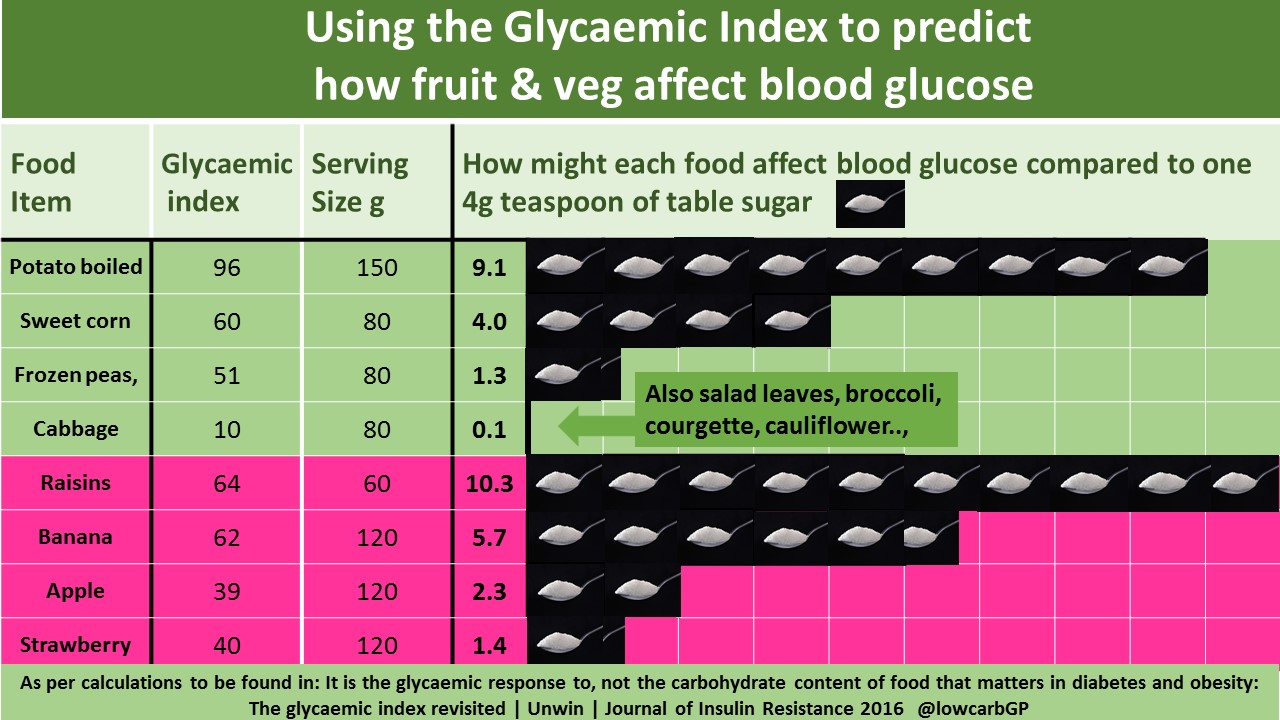
The teaspoon-of-sugar method is the work of Dr David Unwin, and his sugar infographics are published by the Public Health Collaboration at phcuk.org/sugar and used here with PHC's permission. Full provenance for every food is on the sources page.
Side by side
-
Cabbage
about 1 cup shredded (80g)
0.1 teaspoons
- Raisins
about 1/3 cup (60g)
10.3 teaspoons
- White potato, boiled
1 medium (150g)
9.1 teaspoons