Wholemeal spaghetti is on only one of Dr Unwin’s charts, “White, brown or green foods?”, where the row is labelled “Spaghetti brown”. The chart’s footnote says that its brown bread and brown spaghetti are both wholemeal, and that the spaghetti was boiled.
The chart prints a serve size of 180g, the same plate it uses for white spaghetti on the row above, and a glycaemic load of 17. It has no glycaemic index column, so no GI appears on this page.
Wholemeal pasta is made from flour that includes the whole wheat grain, bran and germ as well as the starchy endosperm. It is darker and firmer than white pasta. Most is still made from durum wheat, and it is shaped and dried in the same way.
The chart describes neither the brands, nor the cooking time, nor the entries in the GI tables its figures came from. Cooking time affects the result for any pasta, and pasta boiled longer and softer is generally listed with higher GI values than pasta cooked firm.
Some pastas sold as “brown” or “wholewheat” blend wholemeal and white flour. The ingredients list shows the flours in order of weight.
A 180g plate describes cooked pasta, which weighs well over twice its dry weight. The white spaghetti page has the full Table 1 working for the other half of the chart’s pairing.
The numbers
- Glycaemic index
- not printed on this source
- Available carbohydrate
- not printed on this source
- Glycaemic load
- 17, as printed on the source
- Teaspoons
- 6.2
Glycaemic load printed on the source: 17
Teaspoons: 17 ÷ 2.73 = 6.2
Source
Read from a published chart: White, brown or green foods? (sugar infographic). Dr David Unwin. Public Health Collaboration.
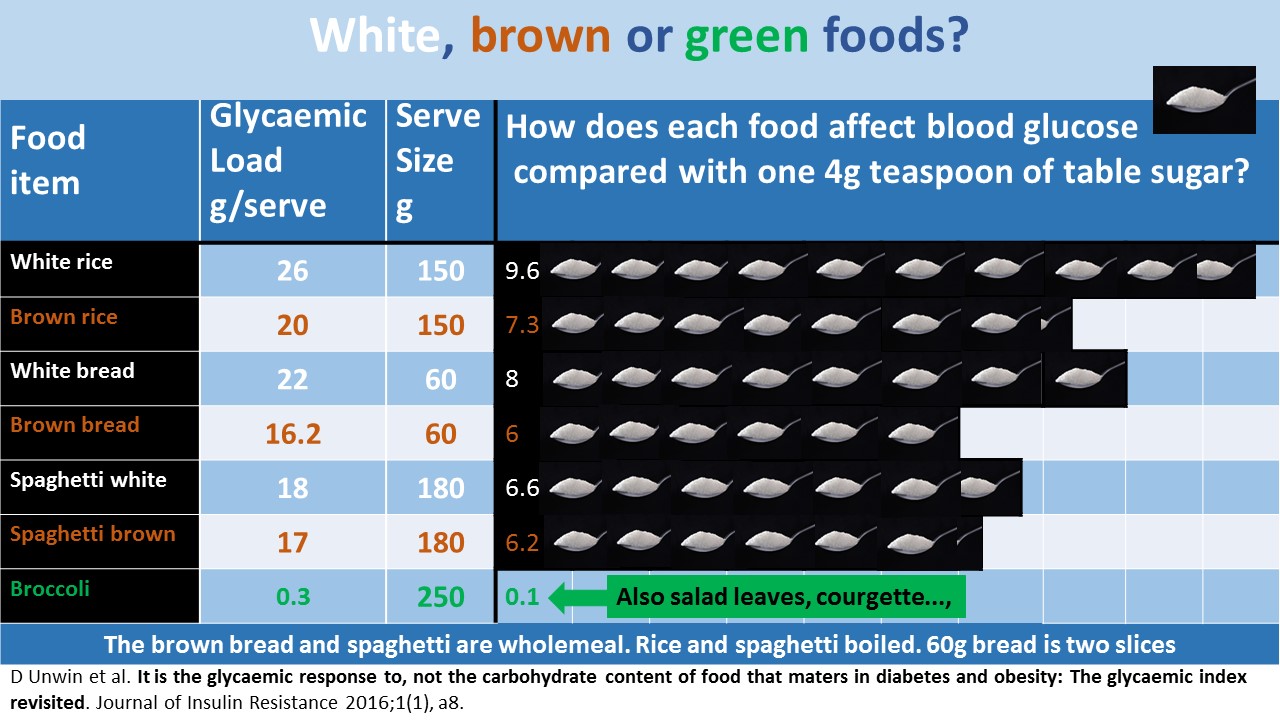
The teaspoon-of-sugar method is the work of Dr David Unwin, and his sugar infographics are published by the Public Health Collaboration at phcuk.org/sugar and used here with PHC's permission. Full provenance for every food is on the sources page.
Side by side
-
Spaghetti, wholemeal, boiled
1 plate, cooked (180g)
6.2 teaspoons
- Broccoli, boiled
about 1 cup (80g)
0.2 teaspoons
- Ground beef patty, 85% lean
1 patty (100g)
0.0 teaspoons