Dr Unwin’s common foods chart gives boiled white spaghetti a glycaemic index of 39, in the low band. The explanation usually offered is the structure of pasta. Durum wheat dough is pressed through a die and dried, which packs the starch into a dense protein network that digestive enzymes break into slowly.
GI is only half of a glycaemic load. The portion here is a 180g plate of cooked spaghetti, and Table 1 of the 2016 paper lists 46g of available carbohydrate in it. Multiplied by the GI and divided by 100, that is a load of 17.94, printed as 18 on both Table 1 and the white, brown or green chart.
The Table 1 row is labelled “Spaghetti white boiled (France)”. The GI tables list pasta by country and by study, and the value depends on the brand, the shape and, above all, the cooking time. Pasta cooked firm, al dente, is generally listed lower than pasta boiled soft.
Three charts include white spaghetti. The common foods and white, brown or green charts both print the same teaspoon figure for 180g. The sugar burden chart gives boiled spaghetti per 100g, at 3.7 teaspoons, in its column of foods digested down into sugars; scaled to 180g, that is 6.7, within rounding.
A 180g plate of cooked spaghetti corresponds to a much smaller weight of dry pasta, since pasta takes up water as it cooks. Packets usually give serving sizes by dry weight.
The sauce is a separate food. Two common sauce ingredients, tomato and mushrooms, have figures from Table 1.
The numbers
- Glycaemic index
- 39
- Available carbohydrate
- 46g
- Glycaemic load
- 18, as printed on the source
- Teaspoons
- 6.6
Glycaemic load: 46g carbohydrate × GI 39 ÷ 100 = 17.94, printed as 18
Teaspoons: 17.94 ÷ 2.73 = 6.6
Source
Read from a published chart: Common foods (sugar infographic). Dr David Unwin. Public Health Collaboration.
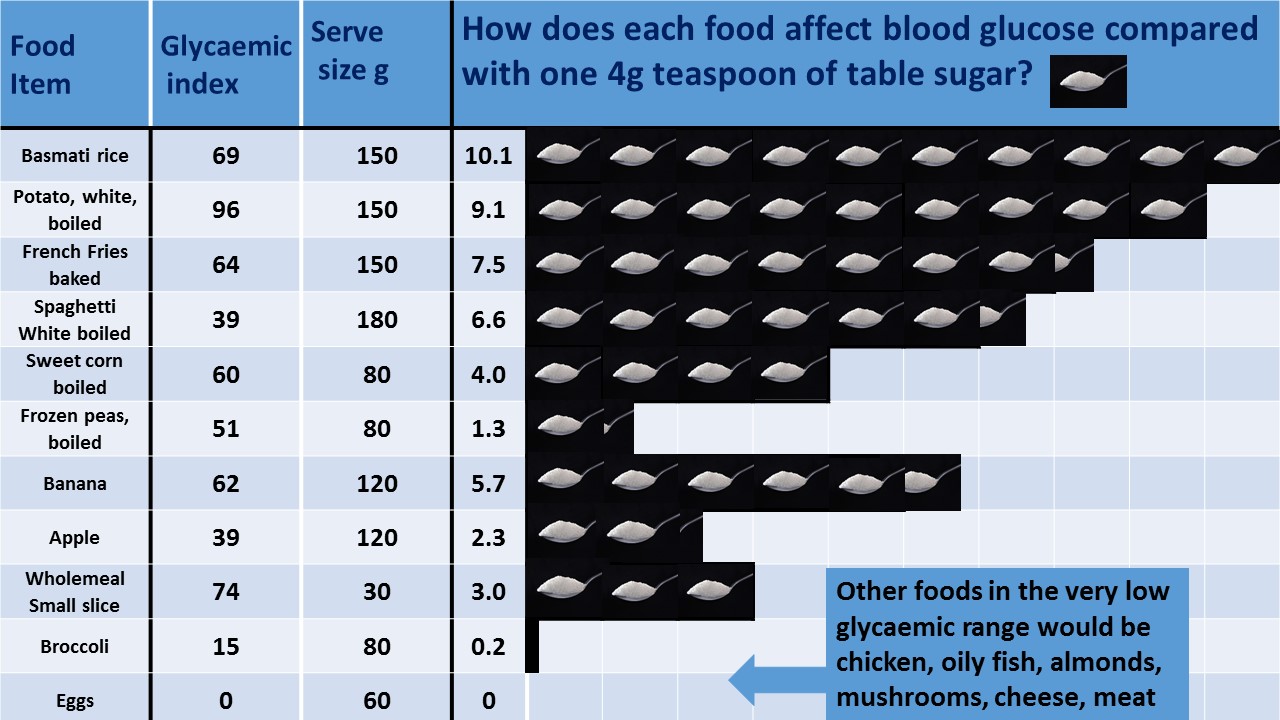
The teaspoon-of-sugar method is the work of Dr David Unwin, and his sugar infographics are published by the Public Health Collaboration at phcuk.org/sugar and used here with PHC's permission. Full provenance for every food is on the sources page.
Side by side
-
Spaghetti, white, boiled
1 plate, cooked (180g)
6.6 teaspoons
- Tomato, raw
1 small tomato (50g)
0.3 teaspoons
- Mushrooms
about 1 cup sliced (80g)
0.1 teaspoons