Okra, called lady’s fingers in the UK and bhindi in South Asia, is the green seed pod of a plant in the mallow family. Cut and cooked, it releases a mucilage that thickens soups and stews, which is why it is central to West African okra soup and to the gumbo of the southern United States.
Okra appears on two of Dr Unwin’s charts, in two different ways. The African and Caribbean foods chart gives it a row of its own, at 100g, with a teaspoon figure. The South Asian foods chart names okra in its side note of foods in the very low glycaemic range, without a figure. The value used here is the printed one.
The African and Caribbean chart prints no glycaemic index and no glycaemic load, and the load on this page was back-calculated from the teaspoon figure.
That chart’s side note lists other foods in the same very low range, several of them specific to West African cooking. Garden egg is a small African eggplant. Jute leaf, called ewedu in Yoruba and molokhia in North Africa and the Middle East, is another leaf that turns soups silky. Wagasi is a soft cheese made by Fulani herders in Benin.
Okra’s carbohydrate is largely fibre, including the soluble fibre that forms the mucilage, with a small amount of sugars and starch.
In a bowl of okra soup, okra is one of several ingredients alongside palm oil, fish or meat, and it is often eaten with a starch such as fufu or eba. Cassava fufu is on the same chart.
The numbers
- Glycaemic index
- not printed on this source
- Available carbohydrate
- not printed on this source
- Glycaemic load
- 0.8, back-calculated from the teaspoon figure
- Teaspoons
- 0.3
Teaspoons printed on the source: 0.3
Glycaemic load: 0.3 × 2.73 = 0.8
Source
Read from a published chart: African and Caribbean foods (sugar infographic). Dr David Unwin and Dr Geoffrey Livesey. Public Health Collaboration.
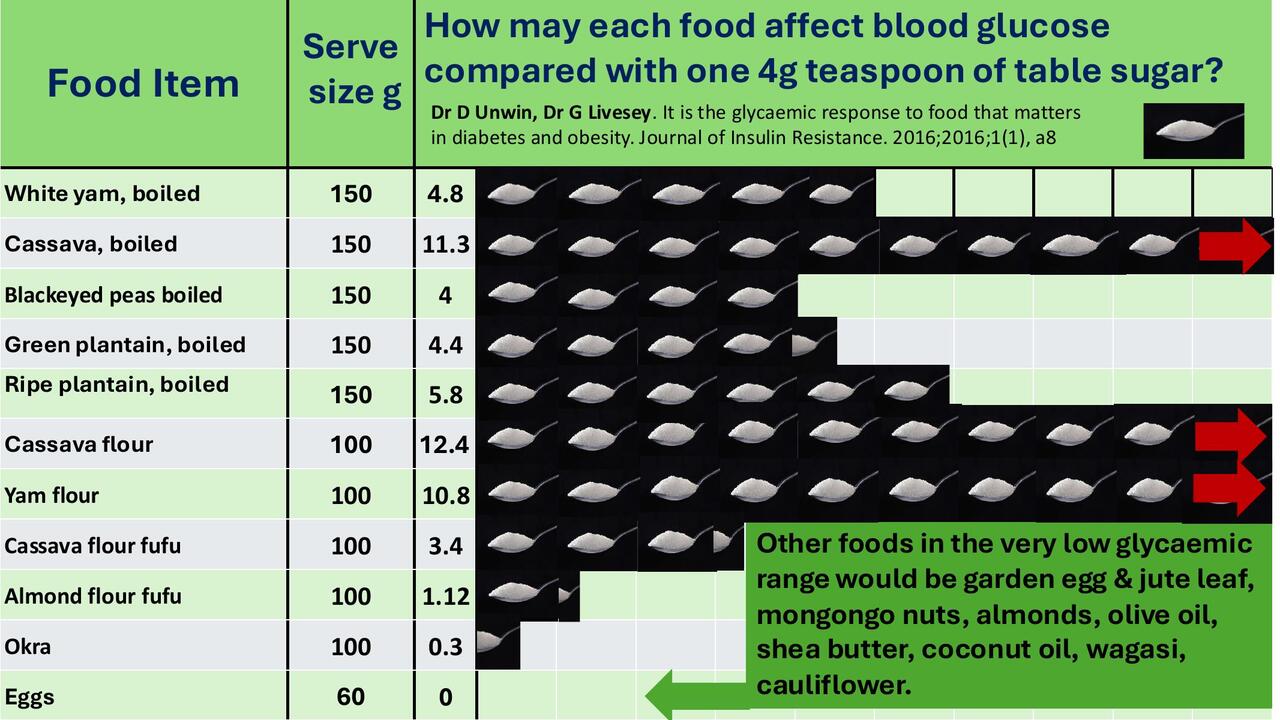
The teaspoon-of-sugar method is the work of Dr David Unwin, and his sugar infographics are published by the Public Health Collaboration at phcuk.org/sugar and used here with PHC's permission. Full provenance for every food is on the sources page.
Side by side
-
Okra
about 1 cup (100g)
0.3 teaspoons
- Cassava, boiled
1 serving (150g)
11.3 teaspoons
- Ripe plantain, boiled
1 serving (150g)
5.8 teaspoons