Cassava, also called manioc or yuca, is a woody root grown throughout the tropics and eaten as a staple across Africa, South America, the Caribbean and parts of Asia. It has to be peeled and cooked before it is eaten, because raw cassava contains compounds that release cyanide, and bitter varieties also need soaking, grating or fermenting. Tapioca is starch extracted from the root.
On the African and Caribbean foods chart, a 150g serving of boiled cassava has the highest teaspoon figure of any fresh food on the chart. Its row is drawn with an arrow because the spoons run off the edge. Only cassava flour, measured dry, is higher.
The chart prints the teaspoon figure alone, with no glycaemic index or glycaemic load. The load on this page was back-calculated from the printed figure, and no GI or carbohydrate weight is shown.
Cassava is almost all starch, with little protein or fat, and it holds less water than many other root vegetables. Boiled cassava is eaten as it is, or pounded into doughs such as fufu. Garri, fermented and roasted cassava granules, is another common form that is not on the chart.
The chart uses 150g for all its boiled foods: white yam, cassava, black-eyed peas and both plantains.
Two other cassava rows on the chart measure the root in processed forms: cassava flour and fufu made with cassava flour.
The numbers
- Glycaemic index
- not printed on this source
- Available carbohydrate
- not printed on this source
- Glycaemic load
- 30.8, back-calculated from the teaspoon figure
- Teaspoons
- 11.3
Teaspoons printed on the source: 11.3
Glycaemic load: 11.3 × 2.73 = 30.8
Source
Read from a published chart: African and Caribbean foods (sugar infographic). Dr David Unwin and Dr Geoffrey Livesey. Public Health Collaboration.
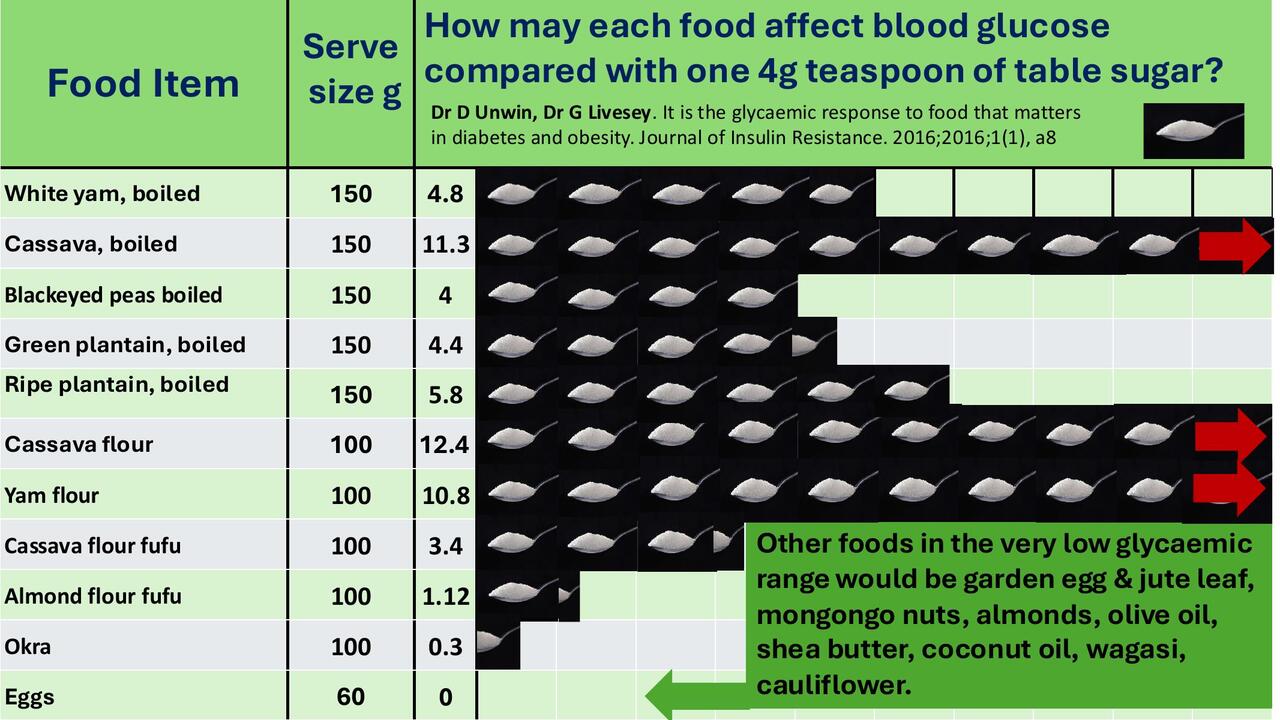
The teaspoon-of-sugar method is the work of Dr David Unwin, and his sugar infographics are published by the Public Health Collaboration at phcuk.org/sugar and used here with PHC's permission. Full provenance for every food is on the sources page.
Side by side
-
Cassava, boiled
1 serving (150g)
11.3 teaspoons
- Okra
about 1 cup (100g)
0.3 teaspoons
- Chicken breast, roasted
1 portion (100g)
0.0 teaspoons