Cassava flour is made by peeling, drying and grinding the whole cassava root. It is used across West and Central Africa to make fufu and other doughs, and elsewhere it is sold as a gluten-free flour for baking. It is not the same as tapioca starch, which is the extracted starch alone.
The African and Caribbean foods chart gives cassava flour a portion of 100g, measured dry. That is a weight of flour, not of a cooked food, and it carries the highest teaspoon figure on the chart. Its row is drawn with an arrow because the spoons run past the edge of the chart.
Dry flours are concentrated. Most of the water in the fresh root has been removed, so 100g of flour holds the carbohydrate of a much larger weight of boiled cassava. Mixed with water and cooked into a dough, the same carbohydrate is spread through a heavier, wetter food.
The chart also has a row for that dough. Fufu made with cassava flour is listed at 100g of prepared fufu, and the chart does not say how much flour went into it.
No glycaemic index or glycaemic load is printed for any food on this chart. The load here was back-calculated from the teaspoon figure.
A figure for dry flour describes an ingredient. Recipes differ in how much flour goes into one serving of fufu, so the figure for a plate depends on the recipe.
The numbers
- Glycaemic index
- not printed on this source
- Available carbohydrate
- not printed on this source
- Glycaemic load
- 33.9, back-calculated from the teaspoon figure
- Teaspoons
- 12.4
Teaspoons printed on the source: 12.4
Glycaemic load: 12.4 × 2.73 = 33.9
Source
Read from a published chart: African and Caribbean foods (sugar infographic). Dr David Unwin and Dr Geoffrey Livesey. Public Health Collaboration.
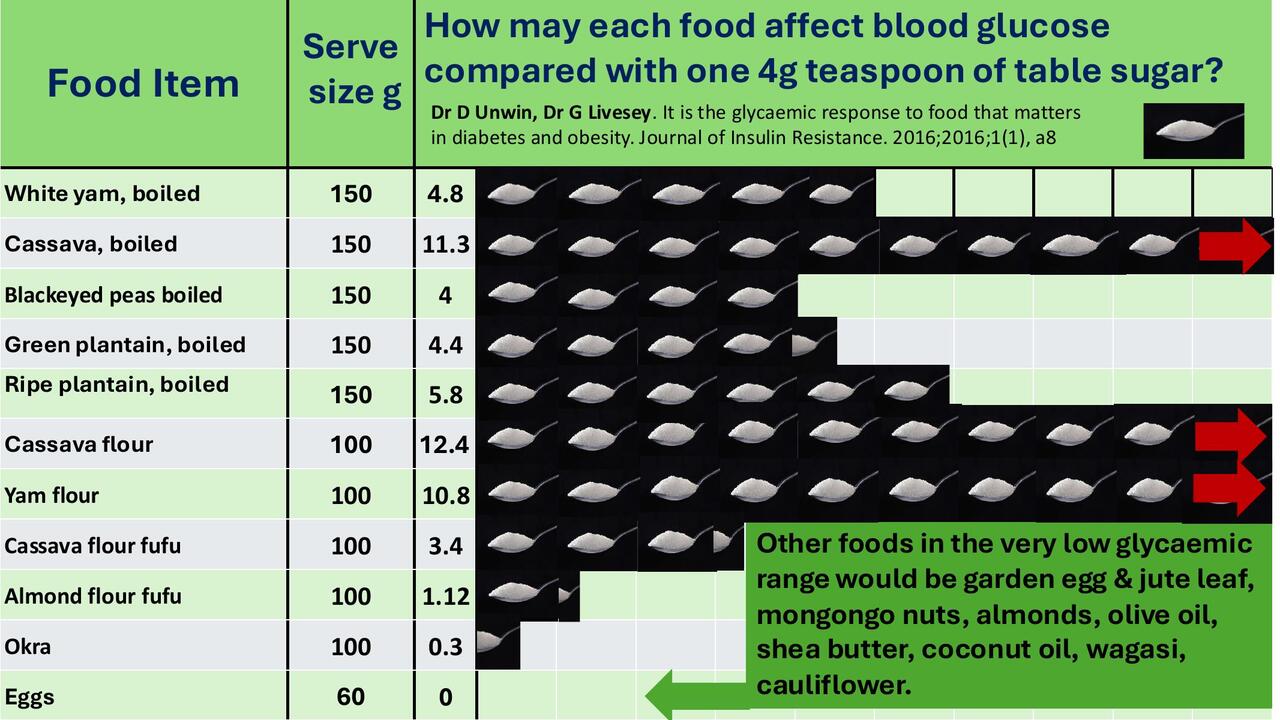
The teaspoon-of-sugar method is the work of Dr David Unwin, and his sugar infographics are published by the Public Health Collaboration at phcuk.org/sugar and used here with PHC's permission. Full provenance for every food is on the sources page.
Side by side
-
Cassava flour
100g dry flour
12.4 teaspoons
- Fufu made with cassava flour
1 serving (100g)
3.4 teaspoons
- Fufu made with almond flour
1 serving (100g)
1.1 teaspoons