Mini Wheats are small biscuits of shredded whole wheat, made the same way as shredded wheat but bite-sized. In the UK the name covers more than one product, some plain and some with a sugar frosting on one side. Dr Unwin’s breakfast cereals chart lists the cereal simply as “Mini Wheats” and does not say which version was measured, so this page cannot say either.
That uncertainty matters when reading the figure. A frosted version adds sugar to the wheat, and the GI tables list products under brand names that may cover recipes from different years or countries.
The chart gives a glycaemic index of 59, at the lower end of the medium band, for a 30g dry bowl without milk. Plain shredded wheat, on the row below, is listed at 67.
The chart prints a teaspoon figure but no glycaemic load. The load on this page was worked back from the teaspoon figure and is shown so that every food page carries the same measures; it is not a separately published number.
Shredded wheat cereals are made by cooking whole wheat grains, rolling them into thin strands and layering the strands into biscuits before baking. The grain is whole, but it has been cooked and pressed, which changes how easily its starch is reached by digestive enzymes compared with an intact kernel.
The breakfast cereals chart lists seven cereals. All seven are in the calculator under Breakfast cereals, each with a page of its own.
The numbers
- Glycaemic index
- 59
- Available carbohydrate
- not printed on this source
- Glycaemic load
- 12, back-calculated from the teaspoon figure
- Teaspoons
- 4.4
Teaspoons printed on the source: 4.4
Glycaemic load: 4.4 × 2.73 = 12
Source
Read from a published chart: Breakfast cereals (sugar infographic). Dr David Unwin. Public Health Collaboration.
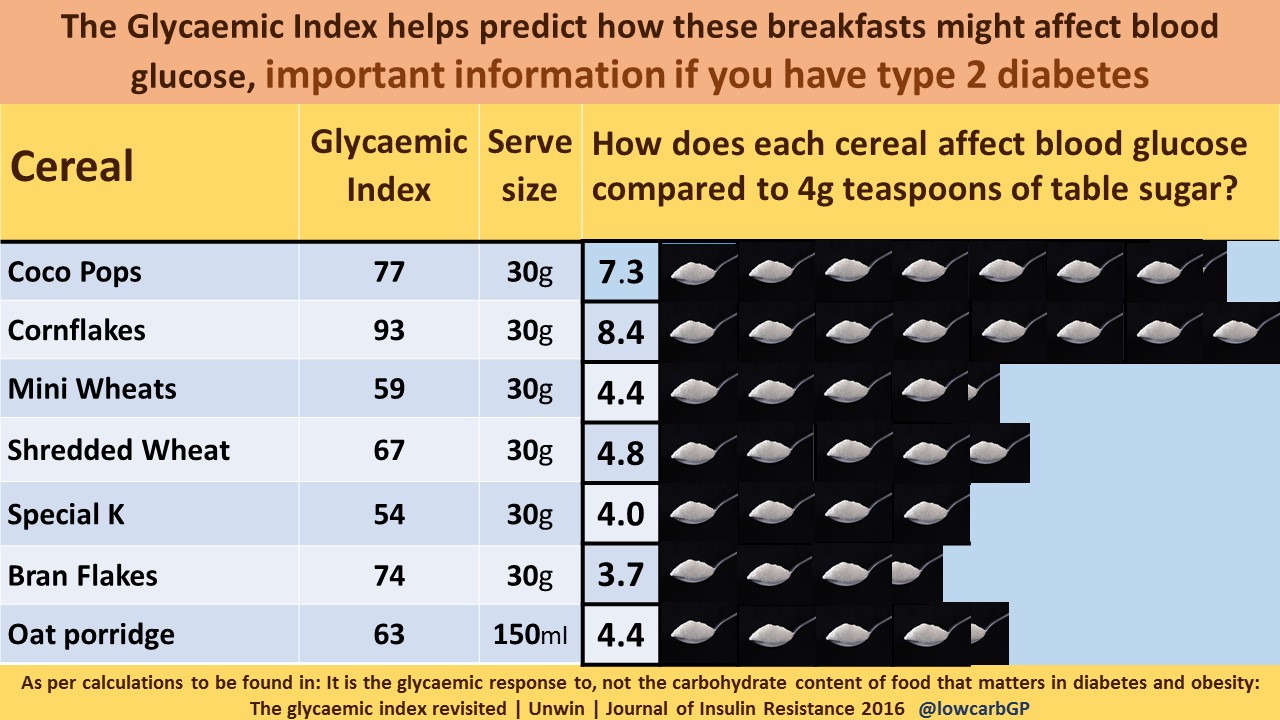
The teaspoon-of-sugar method is the work of Dr David Unwin, and his sugar infographics are published by the Public Health Collaboration at phcuk.org/sugar and used here with PHC's permission. Full provenance for every food is on the sources page.
Side by side
-
Mini Wheats
1 bowl, dry (30g)
4.4 teaspoons
- Raisins
about 1/3 cup (60g)
10.3 teaspoons
- Peas, frozen, boiled
about 1/2 cup (80g)
1.3 teaspoons