Special K is a Kellogg’s cereal of thin toasted flakes, marketed for many years around weight control. Its recipe is not the same everywhere. The UK and US versions have used different grain mixes, and both have changed over the decades. Dr Unwin’s chart describes the UK product, so this figure should not be assumed to fit Special K bought in another country.
The chart gives a glycaemic index of 54, the lowest of the seven cereals it lists, and just inside the band conventionally called low, which runs up to 55. The portion is a 30g dry bowl.
GI and the teaspoon figure answer different questions. GI describes how strongly a fixed amount of a food’s carbohydrate raises blood glucose. The teaspoon figure also depends on how much carbohydrate a real portion contains. The chart prints the teaspoon figure for 30g and no glycaemic load, so the load here was back-calculated.
Flavoured versions of Special K, with dried fruit, chocolate pieces or clusters, are separate products with different recipes and are not covered by this row. Neither are the brand’s bars and shakes.
Other cereals from the same chart have pages of their own, and a breakfast of cereal with milk, toast and juice can be added up food by food in the calculator.
The numbers
- Glycaemic index
- 54
- Available carbohydrate
- not printed on this source
- Glycaemic load
- 10.9, back-calculated from the teaspoon figure
- Teaspoons
- 4.0
Teaspoons printed on the source: 4.0
Glycaemic load: 4.0 × 2.73 = 10.9
Source
Read from a published chart: Breakfast cereals (sugar infographic). Dr David Unwin. Public Health Collaboration.
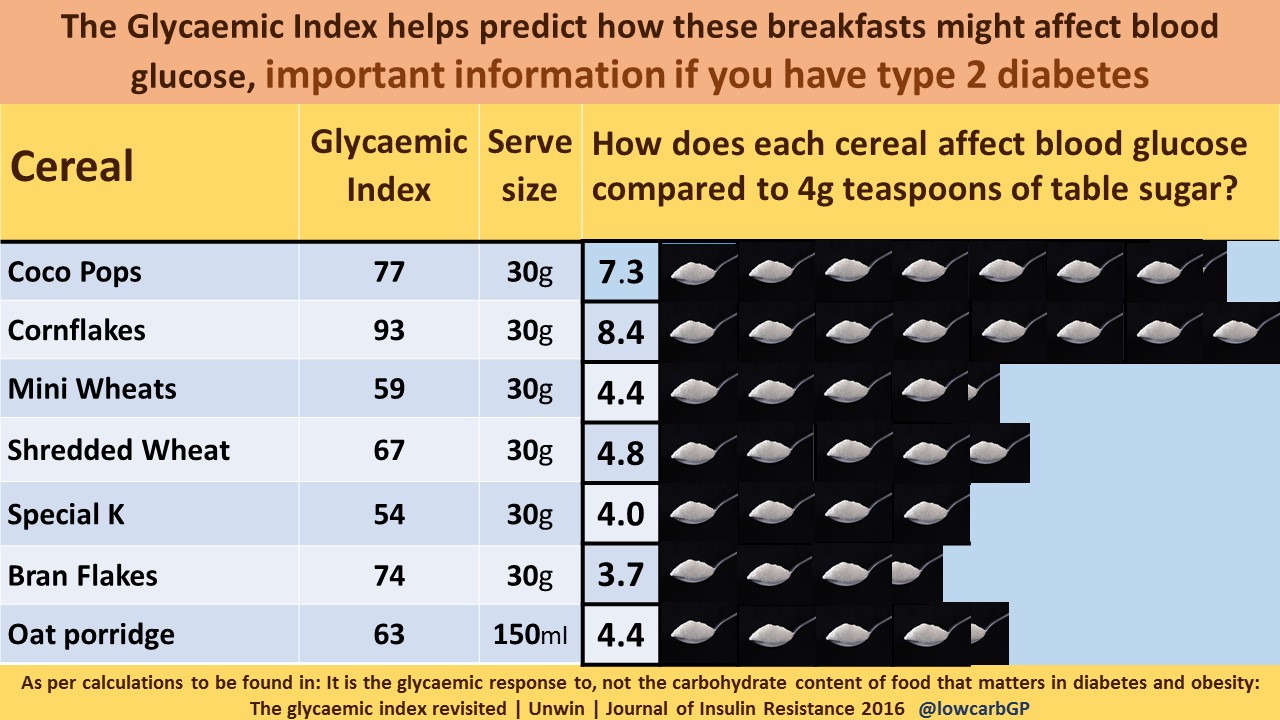
The teaspoon-of-sugar method is the work of Dr David Unwin, and his sugar infographics are published by the Public Health Collaboration at phcuk.org/sugar and used here with PHC's permission. Full provenance for every food is on the sources page.
Side by side
-
Special K
1 bowl, dry (30g)
4.0 teaspoons
- Cabbage
about 1 cup shredded (80g)
0.1 teaspoons
- Apple juice, pure
1 glass (200ml)
4.0 teaspoons