Honey has the highest teaspoon figure of any food in this dataset, for a portion much larger than a usual serving. Dr Unwin’s sugar burden chart gives it per 100g, which is about five tablespoons, using a tablespoon of 21g from USDA FoodData Central. A spoonful stirred into tea or drizzled on yogurt is a small fraction of that.
The sugar burden chart lists honey in its column of naturally occurring sugars, alongside banana, skimmed milk, raisins and apple juice.
Honey is a concentrated solution of sugars made by bees from flower nectar. Most of it is fructose and glucose in broadly similar amounts, with a little sucrose and other sugars, and around a fifth is water. Its composition varies with the flowers the bees fed on, and so does its GI: honeys high in fructose, such as acacia, tend to be listed lower in the GI tables than honeys with more glucose.
The chart prints no glycaemic index or glycaemic load, only the teaspoon figure per 100g. The load here was back-calculated from it.
A figure per 100g scales down simply: a tenth of the weight is a tenth of the figure. The calculator adds 100g per tap, so a single spoonful is a fraction of one portion.
Table sugar, the unit behind every figure on this site, is described on the page what is glycaemic load.
The numbers
- Glycaemic index
- not printed on this source
- Available carbohydrate
- not printed on this source
- Glycaemic load
- 48, back-calculated from the teaspoon figure
- Teaspoons
- 17.6
Teaspoons printed on the source: 17.6
Glycaemic load: 17.6 × 2.73 = 48
Source
Read from a published chart: The sugar burden (sugar infographic). Dr David Unwin. Public Health Collaboration.
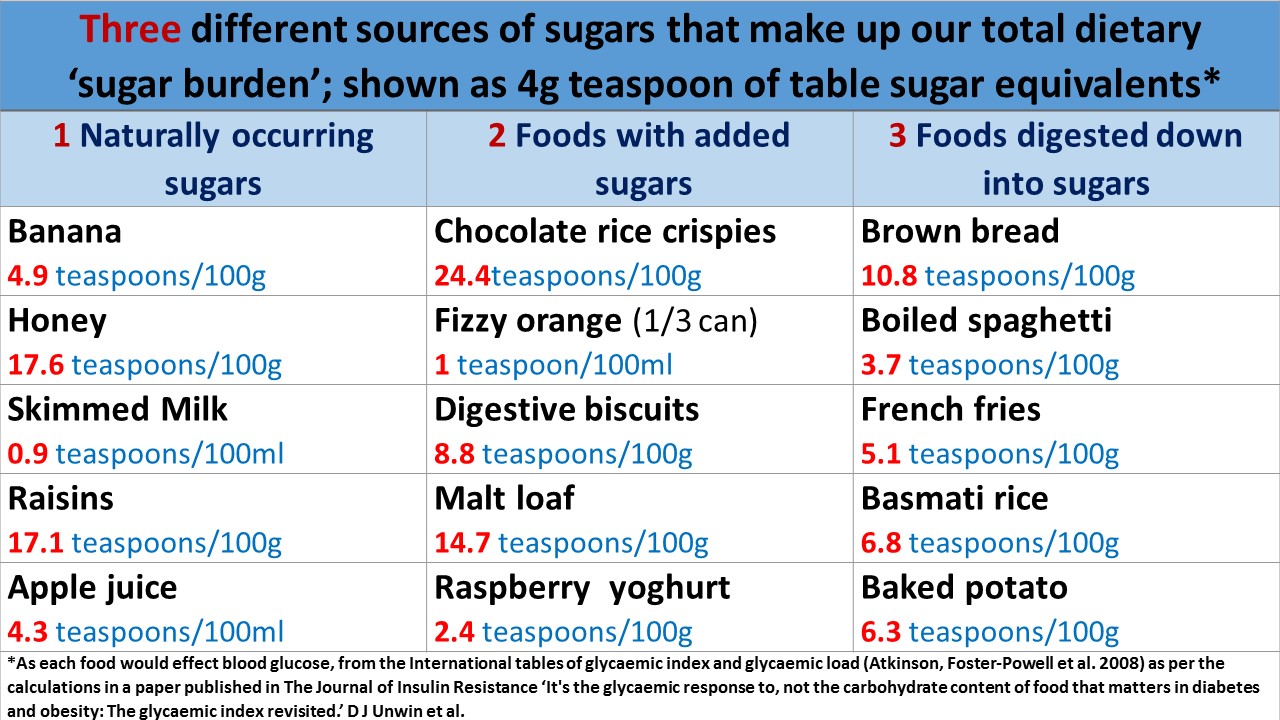
The teaspoon-of-sugar method is the work of Dr David Unwin, and his sugar infographics are published by the Public Health Collaboration at phcuk.org/sugar and used here with PHC's permission. Full provenance for every food is on the sources page.
Side by side
-
Honey
100g (about 5 tablespoons)
17.6 teaspoons
- Greek-style yogurt
1 pot (200g)
0.4 teaspoons
- Eggs
1 large egg (60g)
0.0 teaspoons