Coco Pops is Kellogg’s chocolate-flavoured puffed rice cereal, sold in some countries as Cocoa Krispies or Choco Krispies. Dr Unwin’s breakfast cereals chart lists it under its UK name, with a dry portion of 30g, before any milk is added. Many cereal boxes give a 30g serving, though bowls poured at home are often larger.
Its carbohydrate arrives in two forms at once. Puffed rice is starch, which digestion turns into glucose, and the chocolate coating adds sugar. The teaspoon figure covers both. The “of which sugars” line on the box counts only the second.
The chart gives a glycaemic index of 77 and prints no glycaemic load, so the load shown here was worked back from the teaspoon figure.
A second chart agrees with the value. The sugar burden chart places “chocolate rice crispies” in its column of foods with added sugars, at 24.4 teaspoons per 100g. Scaled to a 30g bowl, that is 7.3, the same figure printed on the cereals chart.
Branded cereal recipes change over time and differ between countries, and the chart does not say when or where the product it describes was tested.
Milk poured over the cereal is a separate food in the calculator: whole milk is listed per 250ml glass.
The numbers
- Glycaemic index
- 77
- Available carbohydrate
- not printed on this source
- Glycaemic load
- 19.9, back-calculated from the teaspoon figure
- Teaspoons
- 7.3
Teaspoons printed on the source: 7.3
Glycaemic load: 7.3 × 2.73 = 19.9
Source
Read from a published chart: Breakfast cereals (sugar infographic). Dr David Unwin. Public Health Collaboration.
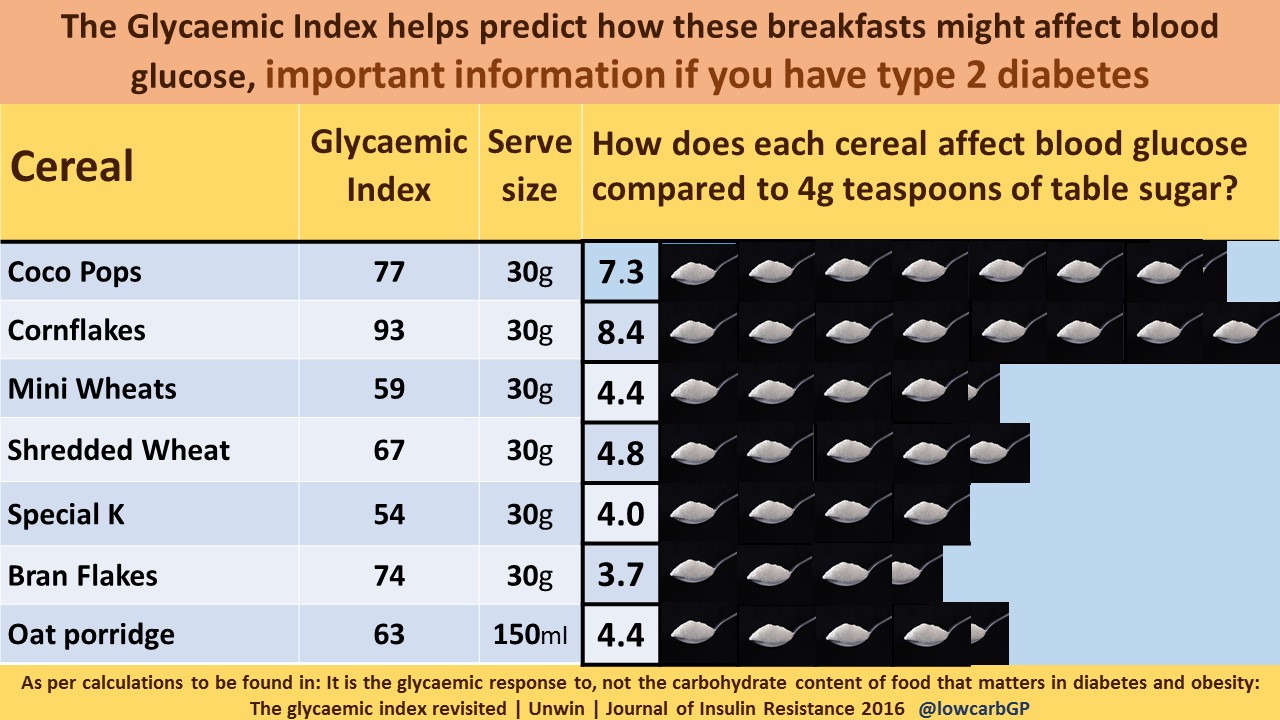
The teaspoon-of-sugar method is the work of Dr David Unwin, and his sugar infographics are published by the Public Health Collaboration at phcuk.org/sugar and used here with PHC's permission. Full provenance for every food is on the sources page.
Side by side
-
Coco Pops (chocolate puffed rice)
1 bowl, dry (30g)
7.3 teaspoons
- Eggs
1 large egg (60g)
0.0 teaspoons
- Greek-style yogurt
1 pot (200g)
0.4 teaspoons