Shredded wheat is one of the oldest ready-to-eat breakfast cereals, first made in the 1890s. Whole wheat grains are boiled, rolled into thin strands and pressed into pillow-shaped biscuits, then baked. The plain version usually contains nothing but whole grain wheat, with no added sugar or salt.
Dr Unwin’s breakfast cereals chart gives shredded wheat a glycaemic index of 67, towards the top of the medium band, for a 30g dry bowl. How many biscuits make up 30g depends on the size of the brand’s biscuits.
The chart prints the teaspoon figure and no glycaemic load. The load here was back-calculated from it.
The row above shredded wheat on the chart, Mini Wheats, is made in a similar way in smaller pieces and is listed with a GI of 59. The chart does not explain the difference; the two may come from different studies of different products.
A cereal with no added sugar still has a teaspoon figure. The figure describes the effect of all the carbohydrate in the bowl on blood glucose, and nearly all of the carbohydrate in wheat is starch. The “of which sugars” line on the box and the teaspoon figure measure different things, and one can be close to zero while the other is not.
The other six cereals from the chart, from cornflakes to oat porridge, are listed under breakfast cereals.
The numbers
- Glycaemic index
- 67
- Available carbohydrate
- not printed on this source
- Glycaemic load
- 13.1, back-calculated from the teaspoon figure
- Teaspoons
- 4.8
Teaspoons printed on the source: 4.8
Glycaemic load: 4.8 × 2.73 = 13.1
Source
Read from a published chart: Breakfast cereals (sugar infographic). Dr David Unwin. Public Health Collaboration.
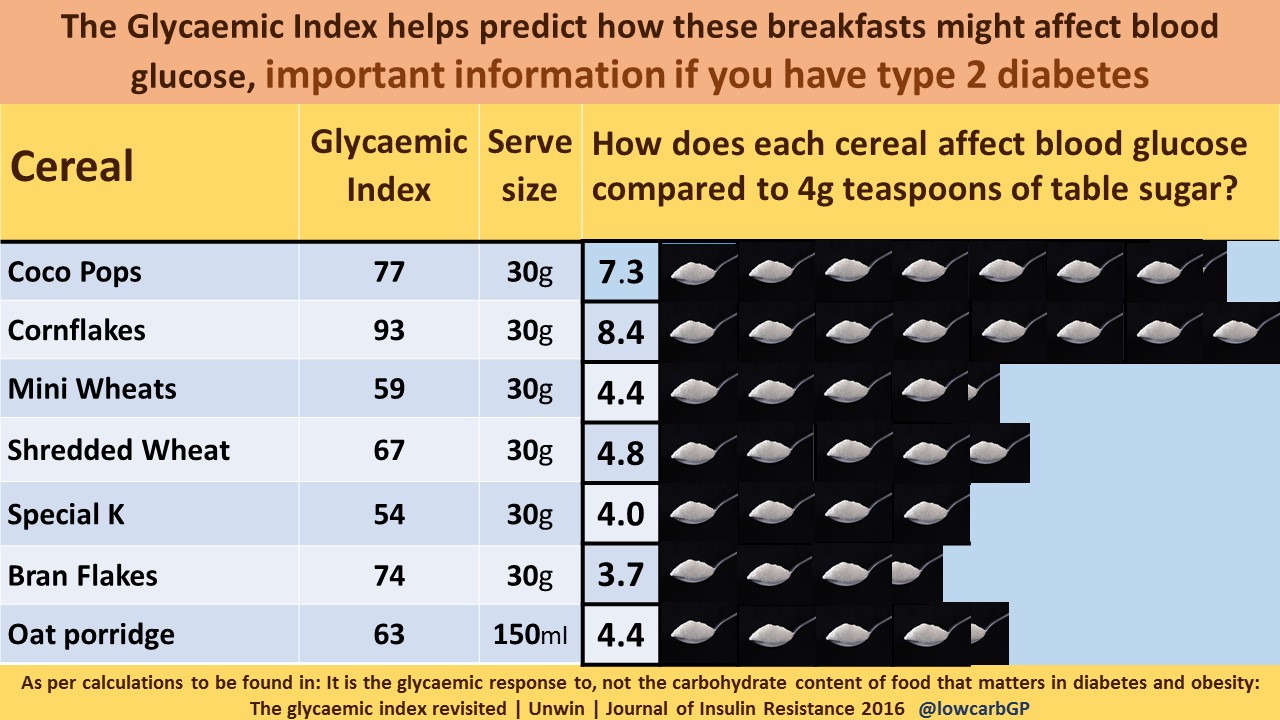
The teaspoon-of-sugar method is the work of Dr David Unwin, and his sugar infographics are published by the Public Health Collaboration at phcuk.org/sugar and used here with PHC's permission. Full provenance for every food is on the sources page.
Side by side
-
Shredded wheat
1 bowl, dry (30g)
4.8 teaspoons
- Apricots, fresh
about 3 apricots (120g)
1.1 teaspoons
- Chicken breast, roasted
1 portion (100g)
0.0 teaspoons