The rye loaf on Dr Unwin’s bread chart is one recipe, not rye bread in general. The chart describes it as containing 69% whole-grain rye flour and does not name the rest of the flour. Rye breads range from light loaves made mostly with wheat flour to dense, dark breads made almost entirely from rye meal or cracked kernels, and those would not be expected to test alike.
The chart gives this bread a glycaemic index of 78, the second highest of its seven loaves. GI values on the charts come from the international tables compiled at the University of Sydney, which average the results of individual studies. One tested recipe can land higher or lower than a loaf from a different bakery.
The glycaemic load of 11 and the teaspoon figure are both printed on the chart, for the same 30g slice used on every row.
Whole-grain rye flour is milled from the entire kernel, but milling it fine changes how it behaves. Dense breads made from whole or cracked rye kernels are generally reported to test lower than loaves made from finely milled flour, because enzymes reach the starch in intact pieces of grain more slowly. The chart does not say how the flour in its loaf was milled or whether the bread was a sourdough.
The other breads on the same chart, from the stoneground wholemeal slice to the wholegrain barley loaf, each have a page under breads.
The numbers
- Glycaemic index
- 78
- Available carbohydrate
- not printed on this source
- Glycaemic load
- 11, as printed on the source
- Teaspoons
- 4.0
Glycaemic load printed on the source: 11
Teaspoons: 11 ÷ 2.73 = 4.0
Source
Read from a published chart: Bread (sugar infographic). Dr David Unwin. Public Health Collaboration.
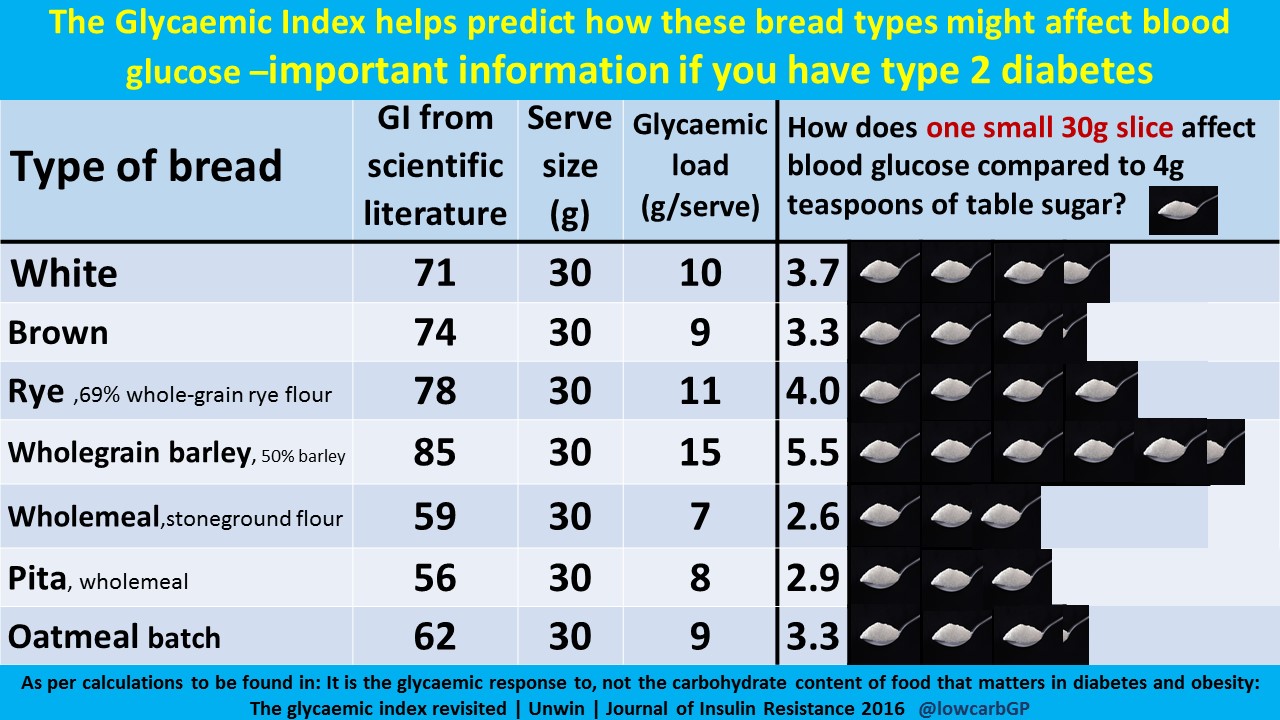
The teaspoon-of-sugar method is the work of Dr David Unwin, and his sugar infographics are published by the Public Health Collaboration at phcuk.org/sugar and used here with PHC's permission. Full provenance for every food is on the sources page.
Side by side
-
Rye bread (69% whole-grain rye flour)
1 small slice (30g)
4.0 teaspoons
- Mushrooms
about 1 cup sliced (80g)
0.1 teaspoons
- Chickpeas, cooked
about 2/3 cup (100g)
1.9 teaspoons
- Salmon, cooked
1 fillet (100g)
0.0 teaspoons